Reading is one of the most significant achievements in a child's early years. A powerful reading skill can be used to aid study in almost every subject.
However, some children find it difficult to connect letters with their sounds. They may struggle to blend sounds or recognise unfamiliar words.
This process may be easier and less stressful if early support is in place. Children learn practical knowledge about the way written language works from Phonics.
Effective phonics support helps learners develop these in a step-by-step manner. It also promotes practice regularly with fun and age appropriate activities.
Children who have good phonics foundations should be able to read with more confidence. They develop these early skills which can help them to develop in primary school.
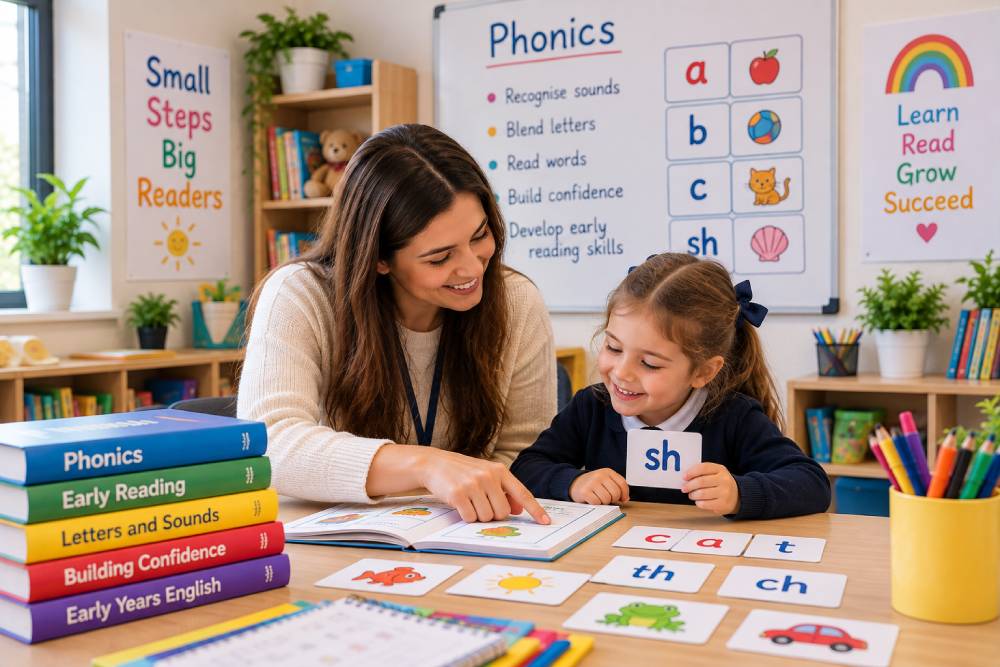
In Phonics children will learn about the relationship between letters and sounds. Children learn to recognise individual sounds within spoken words.
They then relate these sounds to written sounds and combinations. This helps children learn to decipher words they don't know on their own.
For instance, children can be taught that "sh" makes a specific sound. They may then identify the same pattern in various words.
In addition, using phonics helps children to learn spelling patterns. This will provide a better base for literacy and writing skills. The National Literacy Trust's guide to what phonics is offers a helpful overview for parents wanting to understand the approach in more detail.
Key phonics skills include:
These skills develop gradually through consistent teaching and practice.
Early phonics learning gives children important skills before reading becomes more complex. It introduces children to sounds in a structured and manageable way.
Young learners often benefit from repetition and interactive activities. Songs, games, flashcards, stories, and sound-based exercises can make learning enjoyable.
Children can practise individual sounds before moving towards complete words. This gradual approach helps them build confidence.
Early phonics also supports listening skills. Children learn to notice small differences between sounds.
This awareness becomes useful when children begin spelling unfamiliar words. It also helps them pronounce new vocabulary more accurately.
Phonics is closely connected to spelling development. Children learn that spoken sounds can represent particular letters or letter combinations.
This understanding helps them attempt unfamiliar words. They can break words into smaller sounds before choosing the correct letters.
Regular phonics activities can reinforce common spelling patterns. Children gradually become more familiar with these patterns through repeated exposure.
Useful activities can include:
These activities can make spelling practice more structured and engaging.
Struggling with reading can affect a child's confidence. Children may become reluctant to read aloud or attempt unfamiliar words.
Appropriate support can help remove some of these barriers. Small improvements can give children a stronger sense of achievement.
Phonics for primary school children should feel supportive rather than overwhelming. Activities should match the child's current ability.
When children understand how to approach a new word, reading can feel more manageable. They can use their phonics knowledge instead of immediately relying on others.
This independence can encourage children to participate more actively in lessons. It can also create a more positive attitude towards reading.
Not every child learns phonics at the same speed. Some children need additional repetition and individual guidance.
Common challenges can include:
These challenges do not necessarily indicate a lack of ability. Children often need different approaches to understand new concepts.
Additional practice can give learners more time to develop automatic recognition. Individual support can also address specific areas without classroom pressure.
Young children often learn best when activities feel active and enjoyable. Repetitive worksheets may not always maintain their attention.
Phonics activities can include movement, storytelling, games, pictures, and songs. These methods can make sound recognition more memorable.
Reading short books together can also reinforce recently learned sounds. Children can practise identifying familiar patterns within real words. Free, levelled eBooks such as those on Oxford Owl for Home can give children extra practice material that matches what they are learning at school.
Parents can support this learning at home. Simple activities can reinforce classroom teaching without creating unnecessary pressure.
For example, parents can ask children to find objects beginning with a particular sound. They can also practise blending simple words together.
Parents can play an important role in reinforcing phonics skills. Simple activities can become part of everyday routines.
Parents can:
The aim should be to encourage learning without making reading feel like a chore.
Positive encouragement can help children associate reading with achievement and enjoyment. Parents whose children are approaching Year 1 may also find the official GOV.UK phonics screening check guidance useful for understanding how schools assess phonics progress.
Every child develops literacy skills differently. Some learners benefit from additional guidance during their early primary years.
House of Tutors can provide structured learning support for children developing foundational literacy skills. Focused activities can reinforce classroom learning and encourage regular practice.
Individual attention can also help identify areas where children need further support. This can make phonics practice more focused and purposeful.
The goal is to help children develop practical reading skills while building confidence.
Phonics provides an important foundation for early reading and spelling development. Children learn how sounds connect with letters and written words.
Strong foundations can help learners approach unfamiliar words more independently. They can also support spelling, pronunciation, vocabulary, and reading confidence.
Early intervention can be particularly valuable when children experience persistent difficulties. Regular practice can help reinforce essential skills over time.
Parents and educators can work together to create positive learning experiences. With suitable guidance, children can develop stronger literacy habits from an early age.
Give your child the foundation they need for confident reading. Explore House of Tutors and discover suitable phonics learning support today.
Phonics support helps children understand the relationship between letters and sounds. It uses structured activities to develop reading and spelling skills.
Phonics helps children decode unfamiliar words and develop early reading skills. It also supports spelling, pronunciation, and reading confidence.
Children can begin learning basic phonics during their early years. Formal phonics teaching commonly continues through the first years of primary school.