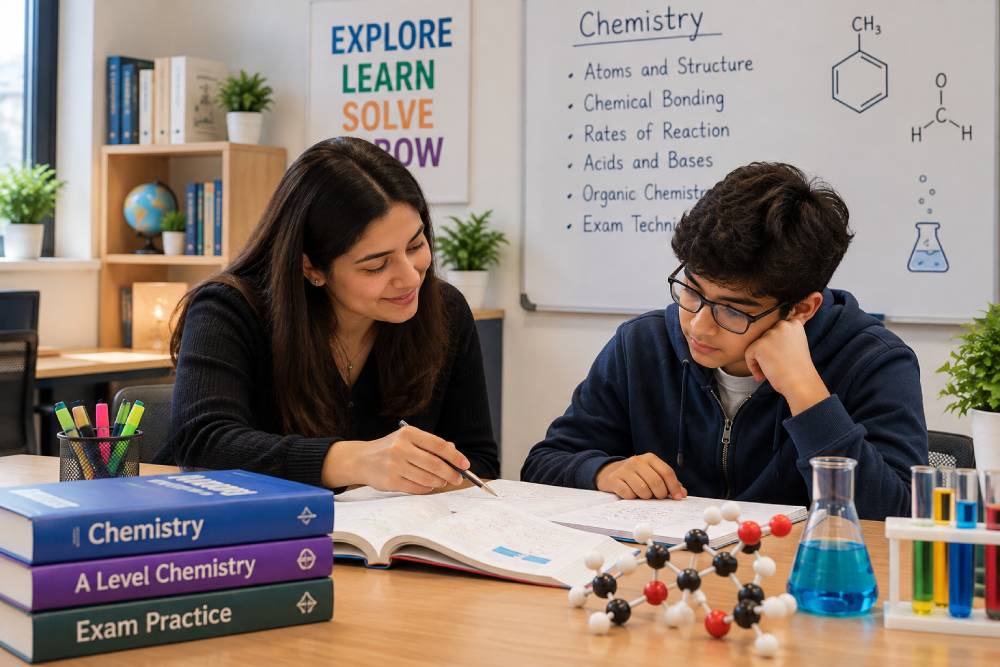
Chemistry can be interesting, and can also get very confusing rather fast. Students might need to learn about equations, particles and reactions, practical skills, and more. When the concepts are multiple and difficult, students may struggle to see how these different ideas connect.
This is where a Chemistry Tutor can make a real difference. The best tutor doesn't just recite textbook answers — they recognise a student's weaknesses, rephrase concepts in a simplified way, and gradually build the student's confidence to face unfamiliar questions.
In Slough, Croydon and Lewisham, personalised chemistry support can also make learning more manageable alongside regular lessons, homework, revision and exam preparation.
Chemistry is not a single, unified subject. It combines scientific knowledge, subject-specific language, mathematical thinking, problem-solving, and practical understanding all at once.
A student may have learned one part of a topic but struggle to apply that knowledge in an exam question, as outlined in the national curriculum for science.
Some typical problem areas include:
The problem is rarely a lack of ability. Occasionally, a student has simply forgotten one of the basic ideas. Once that gap is filled, the following topics usually become much easier to understand.
The biggest advantage of one-to-one tutoring is that lessons can be adapted entirely to the learner.
In a classroom, a teacher has to manage the needs and pace of an entire group. A tutor, by contrast, can focus completely on one student's questions, misconceptions, strengths, and weaknesses.
Chemistry explanations can feel overwhelming when too much information is introduced at once.
A tutor can divide a difficult topic into smaller, manageable stages. For example, when studying chemical bonding, a student might first need to understand electrons and electron shells. From there, they can explore why atoms form bonds before moving on to ionic, covalent, and metallic bonding.
This step-by-step approach helps students understand the reasoning behind the chemistry, rather than memorising isolated facts.
Not every student learns in the same way.
If a textbook explanation is confusing, a tutor can try a diagram, analogy, worked example, practical scenario, or step-by-step walkthrough instead.
For a student struggling with moles, simply repeating the formula may not help. A tutor can explain what a mole actually represents, connect it to particle quantities, demonstrate the calculation, and then work through increasingly challenging examples.
The goal is genuine understanding, not just completing a worksheet.
Confidence usually grows from successful experiences.
When students repeatedly encounter questions they cannot solve, they may begin to assume they are simply "bad at chemistry." That mindset can make them reluctant to attempt challenging problems.
A patient tutor can help change this pattern. Lessons can begin with concepts the student already understands before gradually introducing more demanding questions. As the student successfully completes each stage, they gain real evidence that difficult chemistry is something they can learn.
House of Tutors can be part of that learning journey, providing a structured environment where students can work through difficult chemistry concepts without feeling rushed.
Many advanced chemistry topics depend on knowledge learned earlier in the course.
A student who hasn't fully understood relative formula mass may struggle with mole calculations. Someone uncertain about bonding may find organic chemistry harder later on — a progression reflected in resources from the Royal Society of Chemistry.
A tutor can identify these knowledge gaps and address them before they become bigger problems, creating a stronger foundation for future learning. Instead of repeatedly treating individual symptoms, tutoring helps students understand the underlying concepts that connect different parts of the syllabus — support that fits naturally alongside structured programmes like Key Stage 3 tuition.
Chemistry calculations are a common source of frustration.
Students may know the formula but still make mistakes because they're unsure which information to use, how to rearrange an equation, or how to present their working.
A tutor can teach a consistent method for approaching calculations. For example, students can learn to:
This structured approach, similar to methods referenced in AQA's GCSE Chemistry specification, can make calculations feel far less intimidating. It's particularly useful for topics such as concentration, reacting masses, gas volumes, percentage yield, atom economy, and titration calculations.
Students have different schedules, school experiences, and academic goals, so location-based tutoring can be particularly convenient for families looking for support close to home.
A Chemistry Tutor in Croydon can provide focused support for students who need help keeping up with challenging topics or preparing for important assessments.
Individual sessions can concentrate on current schoolwork, revision priorities, examination questions, or specific areas where the student lacks confidence. For students with busy schedules, personalised tuition can also help make revision more structured and purposeful.
A Chemistry Tutor in Slough can help students work through difficult concepts at a pace that suits them.
Whether the challenge involves chemistry calculations, organic chemistry, equations, or exam technique, one-to-one support gives students an opportunity to ask questions they might hesitate to raise in a classroom. Regular tutoring can also help students maintain consistency rather than waiting until examinations are approaching.
For families looking for a Chemistry Tutor in Lewisham, personalised lessons can provide additional academic support alongside school or college study.
A tutor can review topics the student has already covered, identify gaps, and help prepare them for upcoming assessments. The emphasis should be on developing independent understanding so that students become increasingly comfortable solving problems themselves.
1. What does a Chemistry Tutor do?
A Chemistry Tutor helps students understand difficult concepts through personalised explanations, guided practice, problem-solving, and exam preparation. Lessons can be adapted to the student's specific strengths and areas for improvement.
2. Can a Chemistry Tutor help with GCSE exams?
Yes. GCSE chemistry tutoring can cover challenging syllabus topics, homework, revision, calculations, practical concepts, and exam-style questions. A tutor can also help students improve their approach to longer written and calculation-based questions.
3. Is chemistry tutoring useful for A-Level students?
Yes. A-Level chemistry involves more complex concepts and requires students to connect theoretical knowledge with calculations and practical applications. Personalised tuition can help students address difficult areas while developing stronger problem-solving and examination skills.
4. How often should a student have chemistry tutoring?
There is no single schedule that suits every student. Some learners may benefit from weekly sessions for consistent progress, while others may prefer additional lessons before exams or assessments.