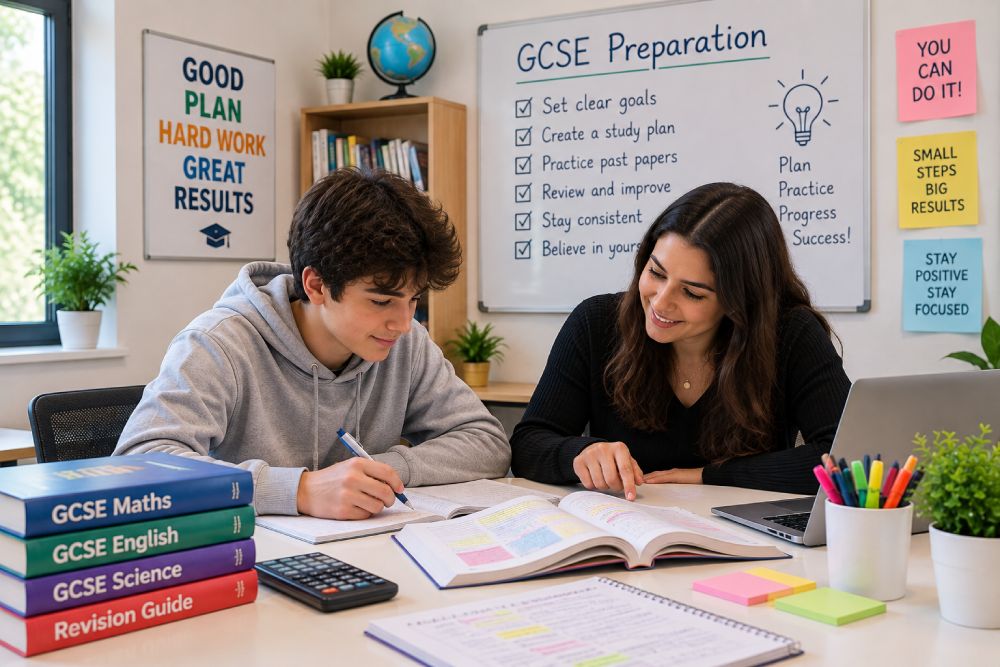
GCSE exams may be daunting, particularly when multiple subjects are required to be studied simultaneously. There are certain things that students can do to make their revision time more manageable and productive, however. Being well-prepared doesn't have to be a 24-hour affair. It is all about learning what to change, learning how to change it, and allowing time to practise.
Whether exams are months away or just around the corner, having a clear plan can make a significant difference. From creating a realistic revision timetable to completing past papers, these practical GCSE revision tips can help students feel more prepared and confident.
One of the most useful pieces of advice for students wondering how to prepare for GCSE exams is to avoid leaving everything until the last minute.
Starting early gives you time to identify difficult topics, revisit important concepts, and practise without unnecessary pressure. You do not need to spend hours revising from the beginning. Even short, regular sessions can help you build knowledge over time.
Begin by making a list of your GCSE subjects. Under each subject, note the main topics you need to cover. This gives you a clearer picture of what lies ahead and helps you divide your workload. Free resources such as BBC Bitesize GCSE revision guides can help you check topic lists and revise each subject in short, manageable chunks.
A revision timetable can give structure to your study sessions, but it should be realistic.
Trying to revise every subject every day can quickly become exhausting. Instead, spread subjects throughout the week and allow enough time for breaks.
For example, you could dedicate certain sessions to mathematics, science, English, and your other GCSE subjects. Give additional time to areas where you feel less confident.
Your timetable should also include:
A timetable should guide your revision rather than make you feel trapped by it.
Simply reading a textbook repeatedly does not always mean you are learning effectively. Active revision encourages you to recall information and use what you have learned.
Try techniques such as:
Flashcards can be useful for definitions, formulas, vocabulary, dates, key terms, and other facts. Test yourself rather than simply reading the answers.
Answering questions helps you understand how knowledge is applied in an exam. It can also reveal topics that need more attention.
Mind maps can help organise related ideas and make complicated topics easier to review. They can be particularly useful when summarising a large topic before moving on.
Explain a topic to a parent, friend, sibling, or even yourself. If you can explain an idea clearly without relying heavily on your notes, you probably understand it well.
These techniques are among the most practical House of Tutors GCSE revision tips for students who want to make their study sessions more purposeful.
Past papers are an important part of GCSE preparation. They allow students to become familiar with the types of questions they may encounter and the way exam papers are structured. You can find official papers and mark schemes on the AQA past papers page, or on the website of your own exam board.
Start by attempting questions without looking at your notes. Once finished, use the mark scheme to check your answers.
Do not just look at your final score. Pay attention to where marks were lost and why.
Ask yourself:
This approach turns mistakes into useful revision opportunities.
Knowing the subject content is important, but students should also understand how their exams work.
Check the specification and make sure you know which topics are included in each paper. Find out how many papers you have, how long each exam lasts, and what equipment you need.
Students should also understand common command words such as explain, describe, compare, evaluate, calculate, analyse, and justify. These words tell you what the question expects.
Understanding the question is often just as important as knowing the subject material.
Some GCSE subjects contain large or challenging topics that can seem impossible to revise in one sitting.
Instead of trying to learn everything at once, break the topic into smaller sections.
For example, rather than writing "revise chemistry," create smaller tasks such as:
Small goals are easier to complete and make progress more visible.
Effective revision is not only about academic work. Physical and mental wellbeing can have a direct impact on concentration and memory.
Try to maintain a regular sleep routine during the revision period. Avoid turning late nights into a habit just to fit in another study session.
Regular meals, movement, fresh air, and short breaks can also help you stay focused.
If exam pressure starts to feel overwhelming, talk to a parent, teacher, tutor, or another trusted adult. Asking for support is a sensible part of preparing for exams. The NHS also offers practical advice on managing stress and anxiety through Every Mind Matters.
Quality matters more than simply counting study hours.
Before starting a session, decide exactly what you want to accomplish. For example, instead of saying "revise biology," set a specific goal such as "complete 20 questions on cell biology and review the mistakes."
Keep your phone away if it distracts you. Have your notes, textbooks, stationery, and other resources ready before you begin.
At the end of the session, spend a few minutes checking what you have learned and deciding what needs to be revisited.
It is natural to spend most of your time on subjects or topics that you find difficult. However, stronger subjects still need occasional revision.
A balanced timetable should help you maintain your existing knowledge while gradually improving weaker areas.
You do not need every topic to feel perfect before moving forward. Consistent review can help keep information fresh.
As exams get closer, your revision strategy may need to change.
Instead of trying to learn everything from scratch, focus more heavily on active recall, past papers, exam technique, and topics where you continue to lose marks.
Create a short list of final revision priorities. Avoid comparing your progress with classmates because everyone starts from a different position.
The goal is to arrive at the exam with a clear understanding of the material and a strategy for approaching questions.
Good preparation should continue into the exam room.
Read the instructions carefully before starting. Look through the paper if you are given time to do so and manage your time according to the marks available.
If a question seems difficult, do not panic. Move on if necessary and return to it later.
For longer answers, take a moment to plan what you want to write. Show your working in calculations where appropriate, and check your answers if you have time.
Most importantly, do not let one difficult question affect your approach to the rest of the paper.
There is no single ideal starting date for every student. Starting several months in advance can give you more time to review topics, practise questions, and address weaker areas without cramming.
Active recall, flashcards, practice questions, past papers, mind maps, and explaining topics in your own words can all be useful. The best combination depends on the subject and how you learn.
There is no fixed number of hours that works for everyone. Focus on productive sessions with regular breaks rather than trying to study for as long as possible.
Yes. Past papers can help you understand question styles, practise time management, identify knowledge gaps, and become more comfortable with exam conditions.
Speak to your teacher or tutor and identify the specific topics causing difficulty. Breaking those topics into smaller areas and practising them gradually can make them easier to manage.
Successful GCSE preparation is built on consistency rather than last-minute cramming. A sensible timetable, active revision, regular practice, and enough rest can help students make steady progress.
There will be difficult topics and days when motivation is low. That is normal. The important thing is to keep your revision organised and adjust your approach when something is not working.